
the cold ocean asks of us silence, asks of us waves, the act, the color of wine, of pouring, of visiting, mourning—it betrays us again each morning, washing up its bitter grapes of morning, stand by it, unripe, bitter, tarnished, spent moneyon, the foam and the seafoam and the petrochemicals of tides, moon in orbit, dawn is inevitable, the pink sunrise, the dew, exhaust pipes in traffic, the hymns, urinals, breathing, machinery, legacies, loneliness, hands grasping at the cold water, cursing the birds, electric wires, face-recognition software, the bodies of earth, my planet, your planet, where things still grow.
–– from The Grimace of Eden, Now by Cody-Rose Clevidence
3 Questions with Esther Kondo Heller
FE Editorial Assistant Emma Riskin emailed with Esther Kondo Heller about their latest work, Ar:range:ments, a poetry collection exploring the word and image of their personal archive, alongside a communal one.
FE: What power does poetry hold for you, and how does your latest title exist within that framework?
Esther: Poetry for me holds the power of speaking the unspeakable. There is a way that a poem can bring forth feelings that can get known over time, space, distance. Through re-reading, poetry, to me, has the ability to change words without necessarily creating new words, but by arranging that which is there and making it sound out differently or bring out different tones and feelings, through techniques such as repetition or line breaks. There is a power in that which differs from rhetoric, which Audre Lorde highlights in her poem Power… Lorde responds to Plato’s warning of the poets, and she places an importance on feeling –– how does this poem make you feel? What do you feel? For me the power of poetry lies in the feelings that are made possible through the arrangement of words, that do not prescribe how you should feel but instead reveal intimate feelings within you which have the potential to change you.
My book Ar:range:ments is working with trying to speak the unspeakable, I am interested in the poetic capability of breaking from one silence to the next—but every break is different even if the words/experiences are the same or sound the same.
FE: In Ar:range:ments, you write, “What is the seed of language? I am writing here in English, a language that M. NourbeSe Phillip calls a foreign anguish. There is a cold-hard and swollen fruit I am pressing to my mouth to carry its pods with me in the pocket of my gums…” Your collection challenges language to image, adapt, cycle, lose, and silence. In reading different languages on the page, whether visually, linguistically, or emotionally, I began to wonder, what is the language of
connection for you?
E: That is a fascinating question. I have been intrigued by the poetic capability of transferring resonances and feeling, regardless of a shared linguistic language. There are emotional resonances that can be transferred by hearing a poem read out loud even if you do not understand the language. For me, a language of connection is made possible in the way that poetry is shared: read, heard, seen, touched, all ways that emotions and feelings are transferred between poet and listener/reader.
FE: What is alive for you right now? Where are you finding movement and inspiration?
E: Works by Raja Lubinetzki, May Ayim, Gloria Naylor, Paule Marshall, Audre Lorde, Toni Morrison, M. NourbeSe Phillip, to name a few, are alive to me. Their writing continually teaches me about art, memory, love, heartbreak, friendships, what it means to be in relationship with others in a real way, the names of flowers, herbs, trees, and rocks…
I am also finding a lot of movement and inspiration in thinking about the ocean, the moon, and caterpillars…and tending to my community garden plot.
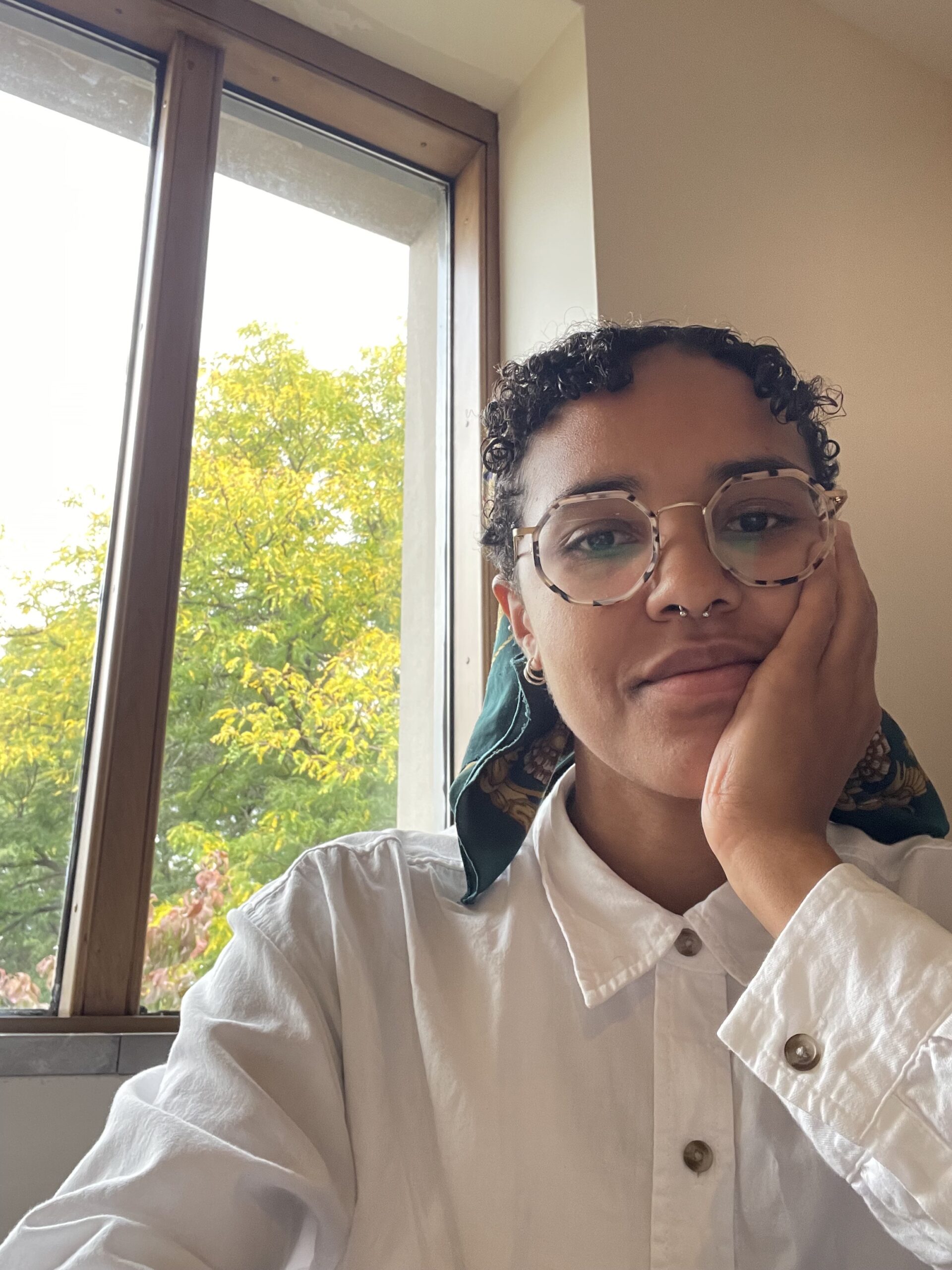
Esther Kondo Heller is a poet, literary critic, and experimental filmmaker. They are a Barbican Young Poet 18/19, an Obsidian Foundation fellow, and a Ledbury Critic. They have an M.F.A. in Poetry from Cornell University 23′ and are currently, a first-year Ph.D. student in Comparative Literature at Harvard University, where they are working on transnational Black poetics.
Through Ar : range : ments,Esther Kondo Heller creates textual & visual language that escapes the page to utter and speak past the record, the archive, and the document. In listening to Black queer life in Berlin, Mombasa, and London, the act of arranging becomes a means of sounding out a collective utterance of Black survival with joy amidst grief, colonialism, medical racism, and loss.
Fonograf Editions Open Genre Book Prize contest runs until Saturday, November 1st. Submissions welcome–more information available via the Fono website!
Also in November, look forward to Fonograf Ed’s inclusion in the Willamette Week Give! Guide, which supports local Portland-area nonprofits. We will share more in the coming months!